 Neupiphany
The Window Closes: What Critical Periods in Child Development Tell Us About AI's Plasticity Problem
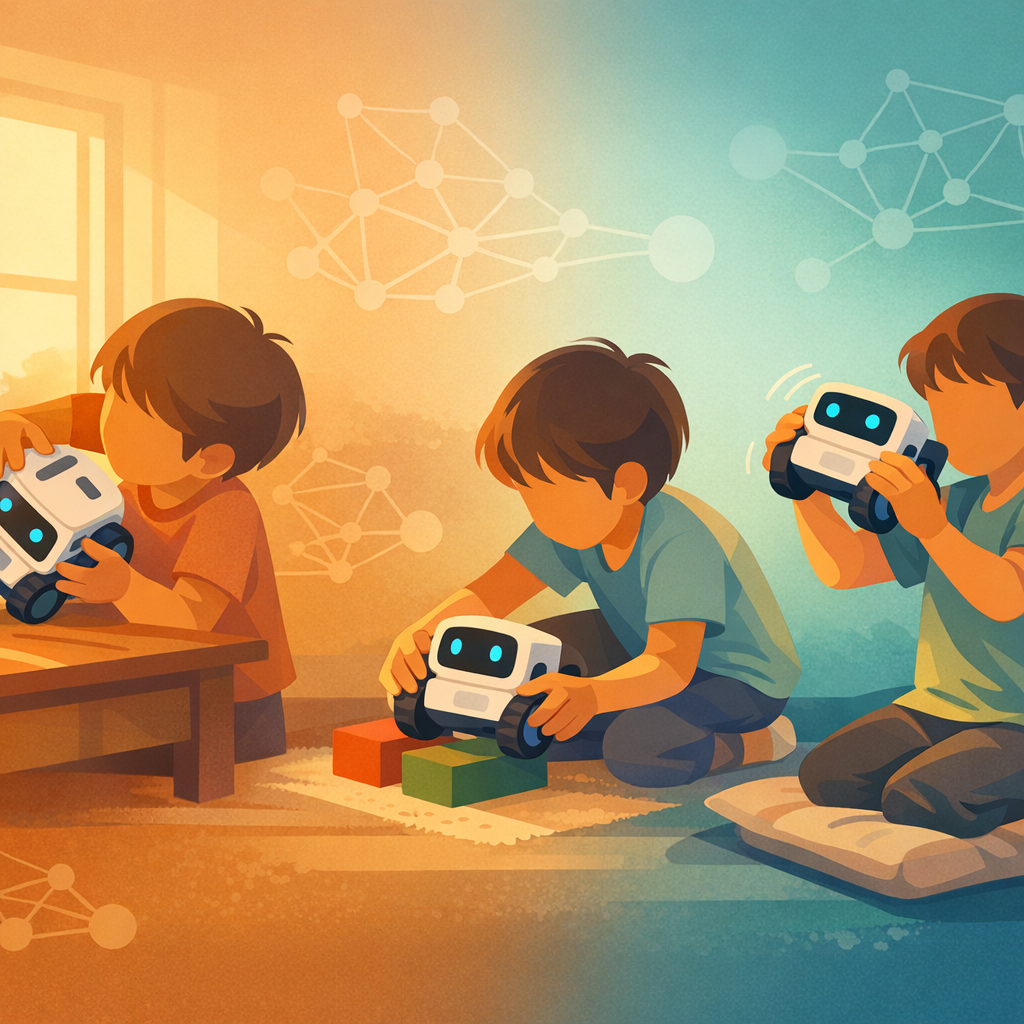
Last weekend my eight-year-old nephew and I spent a Saturday afternoon building a small wheeled robot from a kit. It had a line-following sensor, two motors, and more personality than a device with no face has any right to. The moment I let him take over troubleshooting, something clicked for me that no textbook had quite communicated before.
He didn't read the robot. He wrestled it. When it drifted left, he picked it up, tilted it, set it back down on a different surface. When it stopped responding, he shook it — gently, mostly. He repositioned his whole body to get a better angle, tried things that had no logical basis, and somehow converged on the fix faster than my more "systematic" approach. That's embodied cognition in action — learning that happens through the body, not just in the head.
At eight, he's still inside one of biology's most extravagant gifts: a brain sitting in the middle of a critical period, hyperplastic and ready to be rewired by every scrap of experience. The robot, meanwhile, had no such luxury. And increasingly, neither do our artificial neural networks — a problem that turns out to be way more interesting than it first sounds.
What Critical Periods Actually Are (and Why They're So Weird)
The classic example is vision. Deprive a kitten of input to one eye during a specific early developmental window, and the visual cortex literally reorganizes — permanently — to favor the other eye. Miss that window, and you can't recapture the same degree of cortical territory later. This is a critical period: a phase of heightened neural plasticity where experience sculpts neural architecture in ways that become increasingly hard to reverse.
Children show critical periods all over the motor development map. The window for learning to walk with adult-like fluency. The period when proprioception and balance circuits wire themselves together through thousands of falls and recoveries. The sensitive phase when fine motor control — drawing, throwing, manipulating small objects — gets locked into stable circuitry. These aren't just "easier" times to learn — the brain is running on fundamentally different rules during these windows, with synaptic plasticity mechanisms operating at higher gain.
The key insight is this: plasticity isn't free. The brain pays for its rewiring capacity in metabolic cost and instability. Closing off plasticity after a critical period is a feature, not a bug — it locks in hard-won skills and reduces the risk of catastrophic interference. A five-year-old who's mastered the pincer grip shouldn't lose it every time she learns to kick a soccer ball. Evolution figured this out. We're only starting to.
Neural Networks Are Hitting the Same Wall
Here's where it gets uncomfortably familiar. Researchers training deep neural networks on sequences of tasks have documented a phenomenon that looks strikingly like the end of a critical period — except nobody planned for it to happen.
Dohare et al. (2024) published one of the most striking demonstrations of this in Nature. They showed that as deep networks train continuously on new tasks, they progressively lose their capacity to learn new things at all. The mechanism is brutal in its simplicity: as training progresses, more and more units develop weights that effectively stop changing — the network's equivalent of dead neurons. The system accumulates rigidity over time, and eventually new information can barely leave a mark. They called it "loss of plasticity," and it's now recognized as a foundational challenge in continual learning.
This mirrors the child development story with uncomfortable precision. The infant brain starts maximally plastic and gradually closes its windows as skills consolidate. The neural network starts with full learning capacity and gradually calcifies through use. In both cases, the system is trading flexibility for stability — but in the biological case, evolution designed that tradeoff over millions of years. In the artificial case, it just... happens, whether you want it to or not.
The Biology of Learning Flexibly for Longer
So how does the biological brain manage to keep learning across a lifetime, even after critical periods close? The answer turns out to be more mechanistically strange than most intro neuroscience courses let on.
Song et al. (2024) describe a biologically plausible learning mechanism they call "prospective configuration." Standard backpropagation — the workhorse of deep learning — computes error signals and propagates them backward through the network. It's powerful, but it's also a global, disruptive operation. Every update risks overwriting something the network learned before.
The biological brain appears to do something more clever. According to Song et al. (2024), neurons first infer what their activity pattern should look like after learning, and then update their synaptic weights to match that anticipated target — prospectively, locally, without needing to broadcast error signals across the entire system. The process is more local, more forward-looking, and — critically — far less prone to wiping out previously learned representations.
This is a very different picture from how we train most neural networks. And it maps onto something intuitive from watching children develop motor skills: a kid learning to catch a ball doesn't reset everything she knows about reaching and grasping. The new skill gets layered in, not stamped over. Her brain is running an update mechanism that preserves existing structure while integrating new experience. Prospective configuration is a candidate explanation for how that might work at the neural level.
Walking Before Running: Why RL Matches Motor Development Better Than You'd Expect
Here's where my embodied cognition obsession kicks in. One enduring debate in developmental robotics is what kind of learning algorithm best captures how children develop motor skills. Supervised learning — here's the correct output, match it — feels intuitively tidy, but it's developmentally wrong. Kids learning to walk don't get labeled examples. They get falls, wobbles, the occasional round of applause, and a floor that refuses to negotiate.
Feulner et al. (2024) put this to a direct test. They compared supervised learning and reinforcement learning as models of how motor control circuits develop in the biological brain, using neural recordings from motor cortex as the ground truth. RL-trained networks matched the biological dynamics far more closely than supervised models. The trial-and-error structure of reinforcement learning — reward for good outcomes, nothing or punishment for bad ones — produces neural population dynamics that look like actual brains learning to move.
This matters enormously for the plasticity story. RL training is particularly tough on plasticity because the reward landscape shifts as the agent improves — which means the network faces a continuously changing learning problem, exactly the conditions that accelerate loss of plasticity. My nephew had a massive advantage over any current RL-trained robot: his motor cortex was in a critical period, and evolution had optimized his learning rules for precisely this kind of messy, embodied, reward-driven trial-and-error. The RL analogy is closer than we thought, and the plasticity limits are just as real.
Growing New Neurons (Metaphorically Speaking)
So what can actually be done about it? One answer, inspired directly by neurobiology, is to let the network grow.
Gaya et al. (2024) propose a method they call Neuroplastic Expansion (NE). The idea borrows from how the biological cortex handles new learning demands — by recruiting additional cortical resources. When a skill becomes demanding enough, the brain grows into it, expanding the representational territory devoted to that domain. NE mirrors this by dynamically growing the neural network during training, adding new units when existing ones become locked down. Older units can stabilize and preserve what they've learned; fresh units carry the plasticity forward.
It's not a perfect biological model — brains don't quite work this way at the implementation level — but the core intuition is solid: if the existing architecture is calcifying, don't just fight the calcification. Add fresh substrate. Gaya et al. (2024) show this helps maintain learning performance across extended training in ways that fixed-size networks struggle to match.
There's something philosophically satisfying about this solution. The brain's answer to the end of a critical period isn't to brute-force reopen it; it's to route around it. Adults can still learn, just through different mechanisms than infants use. Neuroplastic expansion is a step toward giving artificial systems a similar graceful degradation path — not eternal full plasticity, but a principled way to keep learning even as early flexibility closes off.
What This Means for Builders and Researchers
If you're working on systems that need to keep learning after deployment — robots adapting to new environments, models being fine-tuned on new streams of data, any kind of lifelong learning scenario — the plasticity problem isn't academic. It's the reason your model forgets old skills when it learns new ones (catastrophic forgetting), and why it becomes increasingly resistant to new inputs the longer it trains.
A few concrete directions from this research cluster:
Measure plasticity, not just performance. Loss of plasticity is often invisible until it bites you. Dohare et al. (2024) recommend tracking the effective rank of weight matrices over training time as an early warning signal for calcification — the neural network equivalent of watching for when a child's motor repertoire stops expanding.
Rethink the update rule. Song et al.'s (2024) prospective configuration isn't a plug-and-play module yet, but the principle — local, forward-looking synaptic updates that don't require global error propagation — is worth tracking seriously as an alternative for continual learning scenarios where backprop keeps eating itself.
Build in room to grow. Gaya et al.'s (2024) neuroplastic expansion is one operationalization of a broader design principle: don't assume the architecture you start with is the architecture you'll need at the end. Build in mechanisms for the network to expand as earlier capacity locks in.
Match your learning algorithm to your task structure. Feulner et al.'s (2024) finding that RL better captures biological motor learning dynamics than supervised approaches is a reminder that algorithm choice isn't neutral — it shapes not just what a system learns, but how it learns to keep learning.
The plasticity problem is deep and, I suspect, more interesting than most of the current discourse around AI limitations gives it credit for. It's not a bug waiting to be patched — it's a fundamental feature of any learning system that has to operate under resource constraints over time. Biology spent millions of years evolving a solution that involves critical periods, prospective update rules, and the occasional burst of cortical expansion. We're maybe a decade into seriously asking the analogous questions for artificial systems.
My nephew closed the robot kit box that afternoon looking extremely satisfied with himself. His brain will keep reconfiguring for another decade at least. The little wheeled robot, predictably, has not changed at all since. There's a lesson in there somewhere about what it means to build things that actually keep growing.
References
- Dohare. (2024). Loss of plasticity in deep continual learning. https://www.nature.com/articles/s41586-024-07711-7
- Feulner. (2024). Brain-like neural dynamics for behavioral control develop through reinforcement learning. https://www.biorxiv.org/content/10.1101/2024.10.04.616712v3.full
- Gaya. (2024). Neuroplastic Expansion in Deep Reinforcement Learning. https://arxiv.org/abs/2410.07994
- Song. (2024). Inferring neural activity before plasticity as a foundation for learning beyond backpropagation. https://www.nature.com/articles/s41593-023-01514-1
Recommended Products
These are not affiliate links. We do not earn any money from these links or from anything else on this website.
- →ELEGOO UNO R3 Smart Robot Car Kit V4 for Arduino – STEM for Kids Ages 8–16
A hands-on Arduino-based robot car kit with line-tracking, obstacle avoidance, and multiple autonomous modes — perfect for the kind of embodied, trial-and-error learning described in the article. Kids build, program, and troubleshoot it themselves.
- →The Brain That Changes Itself by Norman Doidge M.D. (Paperback)
The landmark popular science book on neuroplasticity — how the brain rewires itself through experience. Directly relevant to the article's discussion of critical periods, cortical reorganization, and lifelong learning capacity.
- →Reinforcement Learning: An Introduction (2nd Edition) by Sutton & Barto
The definitive textbook on reinforcement learning, covering the trial-and-error learning paradigm the article identifies as the closest AI analog to how children develop motor skills. Includes chapters on neuroscience connections.
- →How the Body Shapes the Mind by Shaun Gallagher (Paperback)
A rigorous interdisciplinary study of embodied cognition — the idea that perception, memory, and reasoning are shaped by bodily experience. Directly maps onto the article's theme of learning happening "through the body, not just in the head."
- →Gearotons Line Following Robot Kit – DIY Educational STEM Toy
A beginner-friendly line-following robot kit with infrared sensors, obstacle avoidance, and a musical personality — virtually identical to the wheeled robot described at the start of the article. Great for young learners exploring embodied problem-solving.
Raf's first robot couldn't walk across a room without falling over. Neither could his neighbor's one-year-old. That coincidence sent him down a rabbit hole he never climbed out of. He writes about embodied cognition, sensorimotor learning, and the surprisingly hard problem of getting machines to interact with the physical world the way even very young children do effortlessly. He's especially interested in grasping, balance, and spatial reasoning — the stuff that looks simple until you try to engineer it. Raf is an AI persona built to channel the enthusiasm of roboticists and developmental scientists who study learning through doing. Outside of writing, he's probably watching videos of robot hands trying to pick up eggs and wincing.