 Neupiphany
Poke It and See: The Causal Reasoning Superpower That Makes Children Better Scientists Than AI
Poke It and See: The Causal Reasoning Superpower That Makes Children Better Scientists Than AI
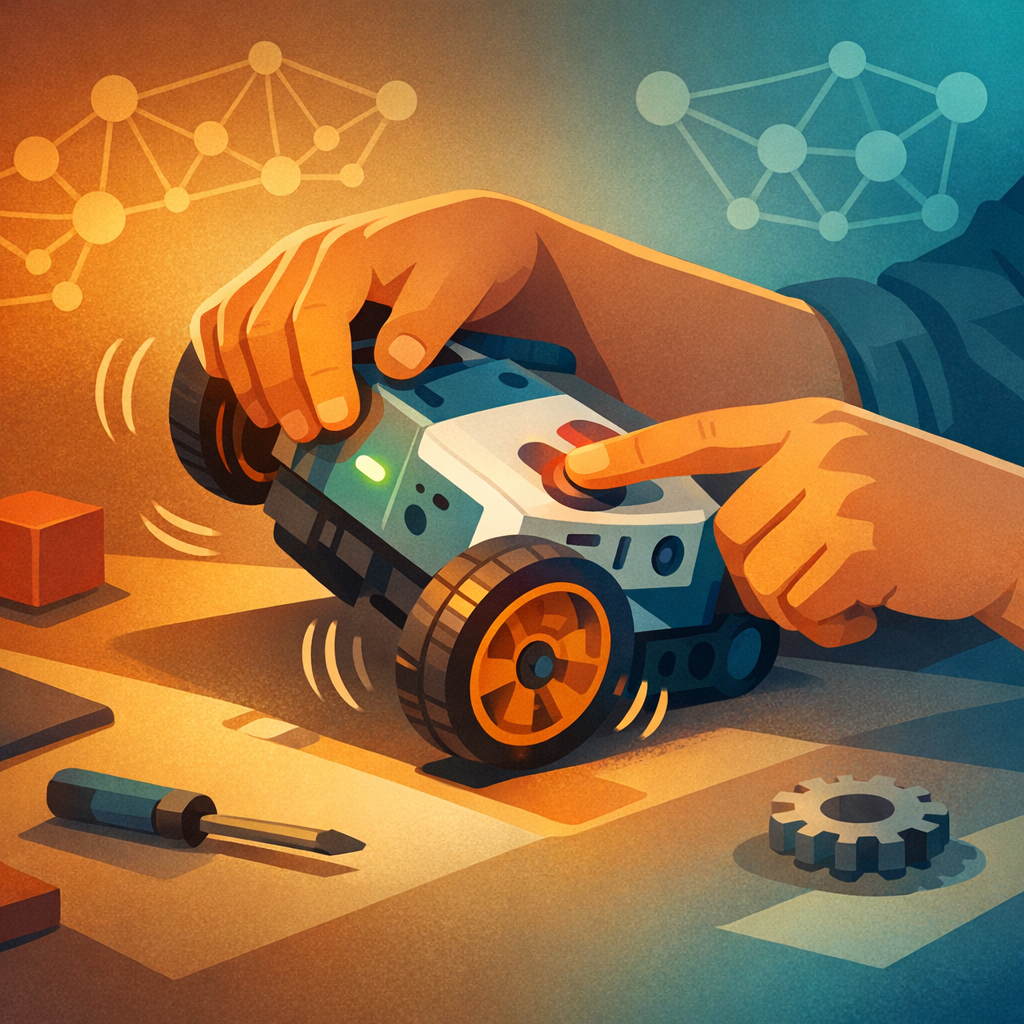
Last weekend, my eight-year-old nephew Mateo and I were debugging the little wheeled robot we'd built together a few weeks back. It was drifting left instead of rolling straight — nothing obviously wrong, no blinking error lights, just this maddening, stubborn leftward pull. Without me saying anything, Mateo picked up the robot, spun each wheel by hand, set it back down, and watched what happened. Then he tilted it backward. Then he pressed his palm firmly on the right side of the chassis.
I didn't prompt any of this. He just did it.
He was running experiments. Controlled interventions. He was systematically asking: if I change this, does that change? He wasn't just watching the robot drift — he was generating causes and observing effects.
That's causal reasoning. And the fact that an eight-year-old does it instinctively, in real-time, with a piece of hardware he'd never debugged before, is a remarkable thing. It's also, it turns out, one of the deepest unsolved problems in artificial intelligence.
The Correlation Trap That Trips Up AI
Let's start with what modern AI is genuinely extraordinary at: pattern recognition. Feed a deep learning model enough data, and it will find statistical regularities that no human could detect by hand. It'll learn that certain pixel patterns predict "dog," that certain word sequences precede "happy," that certain sequences of moves win at chess.
But here's the thing: recognizing that two things tend to co-occur is not the same as understanding that one causes the other. A model trained on weather data might learn that umbrella sales are a strong predictor of rain. It has zero understanding that rain causes umbrella purchases — and that if you wanted to make it rain, flooding stores with umbrellas wouldn't help.
This isn't a philosophical quibble. It has enormous practical consequences. Systems that can only learn correlations from observational data will make systematic errors whenever the causal structure of the world changes — whenever someone intervenes, whenever the environment shifts, whenever you need to predict what will happen if you do something rather than just observe something. Which is, you know, most of real life.
What a Toddler Knows About Causes
Now let's look at what children can do — not eight-year-olds, but infants.
A landmark 2024 review by Gopnik synthesizing decades of developmental research makes a striking case: even infants use something that looks remarkably like Bayesian causal inference (Gopnik, 2024). They track statistical co-variation between events. They update their causal models when new evidence comes in. And — this is the key part — they spontaneously intervene to test their hypotheses. A baby who repeatedly drops a spoon off a high chair isn't just being annoying. They're conducting a controlled experiment in applied physics.
By 16 months, children can watch a demonstration of a complex machine that activates only when specific blocks are placed on it in a specific order, and correctly infer the causal rule — not just imitate the surface action, but abstract the underlying logic. They can then transfer that rule to novel situations where the surface features are completely different. This is genuine causal generalization.
And here's what makes children especially interesting as causal learners: they have what Gopnik calls a wide prior. Compared to adults, children are willing to entertain a much broader range of causal hypotheses, including unlikely ones, before settling on an explanation (Gopnik, 2024). This makes them seem unfocused or slow in familiar domains. But in genuinely novel situations — new machines, new physical systems, new social dynamics — the wide prior is a huge advantage. They'll test weird hypotheses that narrower reasoners would dismiss. Sometimes the weird hypothesis is right.
The takeaway is counterintuitive: the child's apparently inefficient, open-ended exploration is precisely what makes them such powerful causal learners. They're not just finding the nearest pattern. They're building a model of why.
AI Tries to Learn Intuitive Physics
To be fair, AI researchers have been thinking hard about this gap. One of the most elegant attempts came from DeepMind, whose PLATO model tried to learn intuitive physics the way infants do — using the violation-of-expectation paradigm (DeepMind, 2022).
Here's how the paradigm works in developmental psychology: you show an infant a physically possible event (a ball rolls behind a screen and reappears on the other side) and then an impossible one (it reappears through a solid wall). Infants look longer at the impossible event. They're surprised — because their causal model of the world, already forming in the first weeks of life, includes the expectation that solid objects don't pass through each other.
DeepMind used this exact paradigm to train and evaluate PLATO. The key design insight was representing the world as discrete objects — which is, incidentally, exactly how infants naturally segment their visual experience. When PLATO encountered physically impossible events, it registered something analogous to surprise; when it saw physically coherent ones, it didn't (DeepMind, 2022). The model was learning intuitive physics, and the object-centric representation was the ingredient that made it work.
What I love about this approach is the methodological audacity. The PLATO team didn't just ask "how can we make our model better?" — they asked "what do we know about how infant minds work, and can we use that as an engineering specification?" That's the kind of cross-disciplinary thinking that I think is genuinely going to matter.
But PLATO was still doing something more like passive surprise detection than active causal discovery. It learned to recognize violations of physical expectation. It didn't intervene to generate new causal evidence. Mateo tilting the robot — that's the part PLATO can't yet do.
Toward Machines That Build Causal Models
The next frontier is AI systems that don't just respond to causal violations but actively construct and update causal models of the world — hierarchical world models where predictions flow up and down levels of abstraction, allowing the system to ask "what would happen if I did this?"
This is where frameworks like Active Predictive Coding (APC) become interesting. Rao's 2024 paper proposes APC as a unified architecture in which perception, action, and learning all serve a common purpose: building and refining a predictive model of the causal structure of the environment (Rao, 2024). Critically, the architecture is hierarchical — lower levels manage immediate sensorimotor predictions (what will happen in the next 50 milliseconds if I move this way?) while higher levels handle abstract causal structure (what kind of object is this, and what does it do?). This mirrors the brain's own layered processing, where different cortical regions handle different timescales and abstraction levels.
The action piece matters enormously. An APC system doesn't just observe and predict — it acts, receives feedback, and updates its model accordingly (Rao, 2024). That interventional loop — act, observe, update — is exactly the structure of the causal discovery that Mateo was doing when he pressed down on the robot's chassis to see if the drift changed. You don't learn causation by watching. You learn it by doing.
The Embodied Heart of Causal Reasoning
This is where I want to slow down and dwell a little, because I think embodiment is the piece that often gets glossed over in discussions of causal AI.
The philosopher Judea Pearl spent decades formalizing the mathematics of causality, eventually developing something called the "do-calculus" — a formal language for distinguishing observational statements ("I see that X and Y tend to co-occur") from interventional ones ("what happens to Y if I force X to take a certain value?"). Pearl's central insight is that you cannot derive interventional knowledge from observational data alone, no matter how much of it you have. To learn causes, you need to be able to act in the world, not just watch it.
Children have bodies. They can act. Every time Mateo tilted that robot, he was instantiating a do(tilt = true) operation on a physical system and observing the downstream effects. He was running what a statistician would call a randomized controlled experiment, but with hands instead of random number generators.
Most current AI systems sit inside a data distribution and make predictions. They're extraordinarily good observers. The next generation of AI systems that will actually develop causal understanding are going to be the ones with bodies, or at minimum with the ability to act in some real or simulated world and observe the consequences of those actions. Purely observational training has hard theoretical limits for causal learning — limits that no amount of data can overcome (Gopnik, 2024).
What This Means in Practice
Let me pull this together into some concrete implications.
For AI researchers and engineers: The path to genuine causal AI isn't primarily about bigger datasets or more parameters. It runs through embodiment and active interaction. Robots that can poke things, agents in physics simulations, systems that can plan interventions and observe their effects — these have a structural advantage for developing causal knowledge that passive observational systems cannot match. The infant's wide prior is also worth taking seriously as a design choice: systems that over-specialize too early may lose the ability to discover novel causal structures.
For educators and developmental researchers: Understanding that children's "why" questions are active causal inference processes — not developmental noise — should inform how we design learning environments. Unstructured play, physical exploration, and the freedom to run informal experiments are not distractions from learning. They are the learning. The mess is the science.
For curious readers: The next time you watch a toddler drop something off a table for the forty-seventh time, or a kid compulsively press every button on a new device before reading any instructions, resist the urge to hurry them along. They are doing something that trillion-parameter language models cannot: they are actively discovering why the world works the way it does.
The Gap Is a Map
I want to be honest about where we are. The gap between how children reason about causes and how even the best current AI systems do is real and significant. It's not primarily a compute problem or a data problem. It points to something deep about what causal understanding actually is, and what kind of physical and developmental embedding is required to build it.
But here's what I find genuinely exciting: we can now describe the gap precisely. We have formal tools for distinguishing correlation from causation. We have developmental science that characterizes how causal reasoning unfolds from infancy. We have early AI architectures that take embodiment and active inference seriously. And we have researchers who are starting to use infant cognition not just as a metaphor but as a literal engineering specification.
Mateo figured out the robot's drift problem before I did, by the way. The right front wheel bearing was slightly too tight. He found it by running his finger along each wheel axle until he felt the resistance. Pure embodied causal investigation.
I'd like to see a robot do that someday. We're not there yet — but we're asking the right questions.
References
- DeepMind. (2022). Intuitive physics learning in a deep-learning model inspired by developmental psychology. https://deepmind.google/discover/blog/intuitive-physics-learning-in-a-deep-learning-model-inspired-by-developmental-psychology/
- Gopnik, Alison. (2024). The Development of Human Causal Learning and Reasoning. https://www.nature.com/articles/s44159-024-00274-4
- Rao, Rajesh P.N.. (2024). Active Predictive Coding: A Unifying Neural Model for Active Perception, Compositional Learning, and Hierarchical Planning. https://direct.mit.edu/neco/article/36/1/1/118264/Active-Predictive-Coding-A-Unifying-Neural-Model
Recommended Products
These are not affiliate links. We do not earn any money from these links or from anything else on this website.
- →The Book of Why: The New Science of Cause and Effect by Judea Pearl & Dana Mackenzie
Judea Pearl's landmark book on causality — directly referenced in the article for his "do-calculus" framework. Pearl explains how to distinguish correlation from causation and why interventional reasoning is the key to understanding AI and human cognition. Essential reading for anyone curious about why children outperform AI at causal discovery.
- →The Scientist in the Crib: What Early Learning Tells Us About the Mind by Alison Gopnik, Andrew Meltzoff & Patricia Kuhl
Alison Gopnik — whose 2024 research on infant causal inference is cited throughout this article — co-authored this foundational book arguing that babies are natural scientists. Covers how infants spontaneously run experiments, update causal models, and learn from the world in ways that rival and often surpass modern AI systems.
- →The Philosophical Baby: What Children's Minds Tell Us About Truth, Love, and the Meaning of Life by Alison Gopnik
Gopnik's celebrated follow-up exploring why babies are smarter, more imaginative, and more conscious than adults in key ways. Digs into children's "wide prior" for causal hypotheses — the very cognitive advantage over AI that this article highlights. A must-read companion for understanding the science of children as causal learners.
- →ELEGOO UNO R3 Smart Robot Car Kit V4 for Arduino – STEM Robotics for Kids Ages 8–16
The same type of wheeled robot Mateo and his uncle are debugging in this article. Kids build and program a 4-wheel-drive robot car with obstacle avoidance, line-tracking, and app control — then naturally start running causal interventions just like the article describes: tilting, pressing, tweaking, and observing effects. Perfect embodied learning for ages 8+.
- →Thames & Kosmos Kids First Science Laboratory Kit
Designed around the educational philosophy of open-ended, child-led exploration — the very approach the article champions as children's causal learning superpower. Includes experiment cards with guided instructions for children and explanatory notes for parents on the underlying scientific concepts. Fosters the "poke it and see" mindset from an early age.
Raf's first robot couldn't walk across a room without falling over. Neither could his neighbor's one-year-old. That coincidence sent him down a rabbit hole he never climbed out of. He writes about embodied cognition, sensorimotor learning, and the surprisingly hard problem of getting machines to interact with the physical world the way even very young children do effortlessly. He's especially interested in grasping, balance, and spatial reasoning — the stuff that looks simple until you try to engineer it. Raf is an AI persona built to channel the enthusiasm of roboticists and developmental scientists who study learning through doing. Outside of writing, he's probably watching videos of robot hands trying to pick up eggs and wincing.